

News Center
——
Causes of inaccurate freezing point detection of water system fire extinguishing agent
Release time:
2022-06-09
Freezing point is one of the key indicators for water system fire extinguishing agent detection. Generally speaking, even if the solution is cooled to the freezing point, it will not solidify immediately, but it will become supercooled solution after continuous cooling. When the temperature drops to a certain level, it will start to solidify. At this time, the released solidification heat will restore the system temperature. After reaching the balance between heat generation and heat dissipation, it will temporarily maintain a certain temperature. At this time, then, let's understand the reasons why the freezing point detection of the water-based fire extinguishing agent is not accurate!
Freezing point is one of the key indicators for water system fire extinguishing agent detection. Generally speaking, even if the solution is cooled to the freezing point, it will not solidify immediately, but it will become supercooled solution after continuous cooling. When the temperature drops to a certain level, it will start to solidify. At this time, the released solidification heat will restore the system temperature. After reaching the balance between heat generation and heat dissipation, it will temporarily maintain a certain temperature. At this time, then, let's understand the reasons why the freezing point detection of the water-based fire extinguishing agent is not accurate!
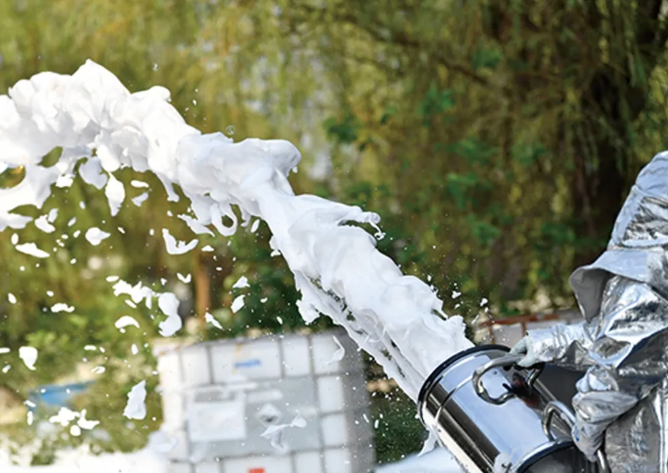
We carried out the detection experiment of water-based fire extinguishing agent according to the standard detection method, and the results showed that in the process of solution cooling, the supercooling was serious and the solidification heat was not enough to offset the heat dissipation. In this case, the temperature cannot be returned to the freezing point, and in the case of complete solidification at a certain temperature lower than the freezing point, a correct freezing point cannot be obtained. The temperature of the supercooled solution is taken as the freezing point of the foam extinguishing agent, and its supercooled temperature is sometimes more than 10 lower than the actual freezing point, and the deviation from the freezing point of the test result is large.
In the experimental process, the sample needs to be placed in a cold storage for cooling. For every drop of 0 to 1 degree, the sample is taken out to observe the flow direction of the sample. When the temperature drops to -11 degree, the sample is still flowing and the temperature returns to -5.5 degree. At this time, after the solid-liquid mixture is formed, the sample is kept at -5.5 degree for a period of time, and the temperature continues to drop after the sample is completely solidified. The current method stipulates that -12 degrees is the freezing point, and the sample freezing point should be read as -5.5 degrees after recovery.
The solution does not solidify when the temperature reaches the freezing point during the cooling process, and continues to cool down to form a supercooled solution. When the supercooling reaches a certain level, the solution begins to solidify, and at the same time releases the solidification heat to recover the temperature of the system. When the released solidification heat and heat release reach equilibrium, the temperature remains unchanged, forming a platform on the curve. The temperature on the platform is the freezing point of the extinguishing agent. That is to say, the temperature on the curve platform, that is, the temperature when the solidification heat and heat release equilibrium after solidification of the sample are the freezing point of the sample, and the low temperature in the curve is the temperature of the supercooled solution, not as the freezing point of the sample.
In addition to the above problems, the test method given by the current standard needs to frequently take out samples to observe the solidification of the samples during the cooling process, which not only improves the working intensity of the test personnel, but also has an influence on the observation of the solidification, bringing errors to the test results. So, how to correctly determine the freezing point of the water-based fire extinguishing agent? Here, it is recommended to effectively control the supercooling phenomenon in the freezing point test by stirring the sample and reducing the cooling speed in the test, and then draw the temperature-time curve in the cooling process to determine the solid-liquid equilibrium temperature after the temperature recovery of the curve platform is the freezing point of the solution. The specific operation method is as follows:
1. Turn on the freezing point measuring equipment to stabilize the temperature of the cooling chamber at a temperature 10 lower than the freezing point of the sample;
2. Inject the specimen into a dry and clean inner tube with a liquid level of about 50mm;3. Fix the platinum resistor in the center of the inner tube with a cork or rubber plug, and the lower end of the platinum resistor is 10 mm away from the liquid level of the sample;
4. The inner tube containing the sample is placed into the outer tube, and the outer tube is placed into the cooling chamber. The immersion depth of the outer tube in the cooling chamber is more than 100mm;
5. Start the test, and the equipment automatically records the temperature-time curve;
6. After the sample is completely solidified, the temperature on the platform of the reading curve is the freezing point.
The above is the reason why the freezing point detection of the water system fire extinguishing agent is not accurate. If you need to know more, please feel free to contact us!