

News Center
——
Main Problems to be Solved in Fluoroprotein Foam Fire Extinguishing Agent
Release time:
2022-06-24
We must have a certain understanding of the fluorine protein foam fire extinguishing agent in the fire, and are interested in the introduction of fluorine protein foam liquid. There must be some details about it you don't know yet. Let's take a look at his related presentation.
We must have a certain understanding of the fluorine protein foam fire extinguishing agent in the fire, and are interested in the introduction of fluorine protein foam liquid. There must be some details about it you don't know yet. Let's take a look at his related presentation.
Fluoroprotein foam fire extinguishing agent is made by adding appropriate fluorocarbon surfactant on the basis of protein foam fire extinguishing agent. Due to the action of the fluorocarbon surfactant, this fire extinguishing agent has the fire extinguishing properties of a protein foam fire extinguishing agent. Can also be used "liquid spray" method to put out the fire of large oil storage tanks, or with the use of dry powder fire extinguishing agent, the fire extinguishing speed is 1/3 faster than the protein foam fire extinguishing agent.
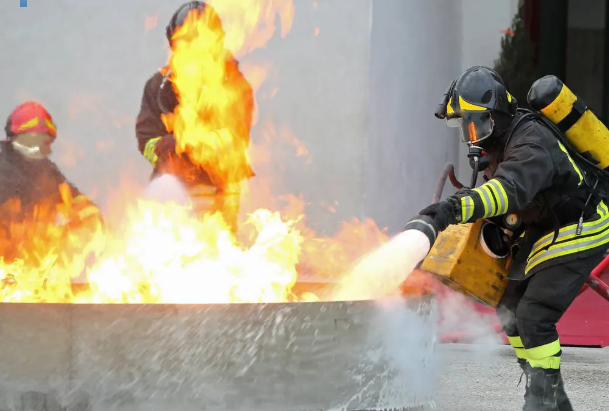
The main problem to be solved by spraying fluoroprotein foam under liquid is how to prevent the foam from entraining too much oil into the combustible foam and losing its fire extinguishing ability. The test shows that when the foam is sprayed under the liquid, the oil entrainment is mainly related to the foaming times of the foam, the speed of the foam into the oil and the thickness of the oil.
1. Reasonable design of foam foaming ratio. The relationship between foaming ratio and oil content was obtained by cold spraying test on a gasoline tank with a diameter of 2.7m and a thickness of 9m. Because the fluorocarbon chain in the fluorocarbon surfactant molecule is hydrophobic and oleophobic, the protein foam can not only form a water film at the interface between the foam and the oil, but also wrap the oil droplets in the foam to prevent the evaporation of the oil and reduce the oil The flammability of the foam.
According to the determination, the fluorine protein foam fire extinguishing agent can only burn freely when the gasoline content exceeds 17%. In order to control the oil content of the foam at a non-combustible concentration and consider its comprehensive fire extinguishing effect, it is more appropriate to control the foaming ratio of the foam at about 3 times. Therefore, when spraying fluoroprotein foam to extinguish fire under liquid, a dedicated high back pressure foam generator should be used, and the working pressure should reach 7105Pa.
2. Reasonable control of the speed of foam into the oil. Entry speed is an important technical parameter. It can be seen from the test that the speed of foam entering the oil increases, and the oil content increases accordingly. This is because, as the flow rate increases, the agitation between the foam and the oil and the turbulence formed by the oil in the oil tank also increase, resulting in an increase in oil content. In order to reduce the oil content of the foam and ensure the fire extinguishing effect, it is necessary to limit the speed of the foam entering the oil.
The test shows that for gasoline, low flash point crude oil and other flammable liquids A and B, 3 times the foaming multiple of fluorine protein foam can not enter more than 3 m/s. Suitable for Class C flammable liquids with high flash point or low volatility, such as kerosene, diesel, etc. The foam entry speed can be slightly higher, but generally cannot exceed 6 m/s. In addition, there is a certain limit to the thickness of the oil in the tank during immersion injection. For example, the thickness of the oil tank is generally not more than 9m.
Through the above introduction, I believe everyone has a certain understanding of fluorine protein foam fire extinguishing agent.