

News Center
——
Fire extinguishing principle of aqueous film-forming foam extinguishing agent
Release time:
2022-07-26
The fire extinguishing principle of aqueous film-forming foam extinguishing agent is that aqueous film-forming foam liquid is usually stored in a fire foam tank. When it takes time to start using fire extinguishing in case of fire emergency, the fire pump supplies fire-fighting water to the fire-fighting foam tank. After a fire occurs, a fire-fighting water proportioning device is prepared from the foam tank to extract aqueous film-forming foam liquid and cooperate with fire-fighting water. A large amount of water film foam is generated by the foam generator, and then sprayed out to extinguish the fire.
Fire extinguishing principle of aqueous film-forming foam extinguishing agent
The oil tank burns fast, the flame temperature is high, the combustion calorific value of the oil is 4-5 times that of the wood, and the surrounding thermal radiation intensity is very high, which is easy to cause the adjacent oil tank to burn and explode. A fire in a large-capacity oil tank may also cause continuous explosion, boiling splash, deformation and collapse of the oil tank, and a fire in the oil tank is very dangerous; then what kind of foam extinguishing agent should we use to extinguish the fire?
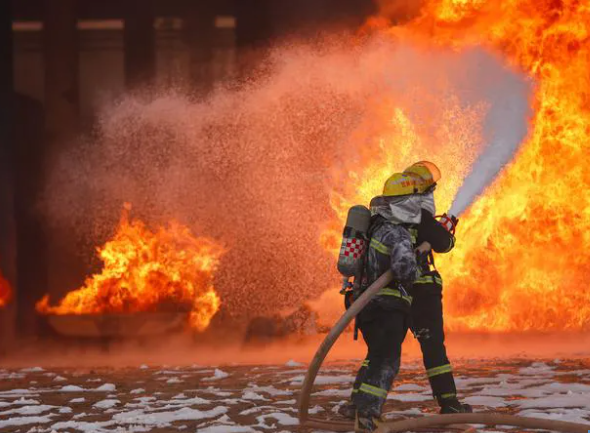
Among the oil fire extinguishing agents, the aqueous film-forming foam fire extinguishing agent can quickly extinguish the fire due to the dual fire extinguishing effect of water film and foam. It is suitable for extinguishing hydrocarbon class A and B fires, such as petroleum products and fuel oil, gasoline, combustibles, etc. and put out the fire by underwater spraying.
The fire extinguishing principle of aqueous film-forming foam extinguishing agent is that aqueous film-forming foam liquid is usually stored in a fire foam tank. When it takes time to start using fire extinguishing in case of fire emergency, the fire pump supplies fire-fighting water to the fire-fighting foam tank. After a fire occurs, a fire-fighting water proportioning device is prepared from the foam tank to extract aqueous film-forming foam liquid and cooperate with fire-fighting water. A large amount of water film foam is generated by the foam generator, and then sprayed out to extinguish the fire. Because the characteristic of water film forming foam is that after covering the fire point, it will automatically form a thin water film. This layer of water film and fire extinguishing foam form a dual role, closely covering the fire point, isolating its contact with the air, so that it suffocates and can not burn. And it is not easy to burst under the action of high temperature, so its fire extinguishing effect is better among all fire extinguishing foam liquids.
Requirements for packaging, transportation and storage of aqueous film forming foam extinguishing agent:
A. product packaging is 25kg, 50kg, 200kg plastic barrel
B. This product shall not be mixed with other chemicals and other foam fire extinguishers during transportation and storage.
C. The product should be stored in a cool and dry warehouse to prevent exposure. The storage environment temperature is -10 ℃ ~ 50 ℃
D. The warranty period of the aqueous film foam extinguishing agent in the above environment is 8 years.
On the basis of meeting the applicable scope of aqueous film foam extinguishing agent, it can also be used in chemical plants, wineries and chemical warehouses that produce and store water-soluble flammable and explosive liquids such as alcohols, esters, ethers, aldehydes, ketones, and organic acids. The anti-soluble aqueous film-forming foam extinguishing agent is a multifunctional environmental foam extinguishing agent, which is used for high-temperature oil fires and is suitable for "liquid injection" fire extinguishing. The water-soluble film-forming foam fire extinguishing agent has a universal fire extinguishing effect. It is widely used in large chemical enterprises, petrochemical enterprises, chemical fiber enterprises, solvent plants, chemical product warehouses, oil fields, oil depots, ships, hangars, garages and other units and places where fuel is easy to leak.